


3 little Snakes
Hi guys, its been awefully quiet on here as of late but we are back with some exciting new projects!
Right now, we have pur ongoing bird monitoring, a hummingbird project, a moth diversity assesment, herpetological monitoring with a focus on the spatial ecology of vipers and a bat survey investigating gut microbiome-habitat interactions. We also have some exciting news regarding our vipers!!
Let us give you some insights to how life has been looking around here as of late:

Here are some pictures from this January. From bat netting with Lauren and our new Bird Bander Alex (yes another one), over releasing a beautiful Bothrops asper back into the reserve, to our one and only Wilo not being very impressed by somebody forgetting to remove a mistnet from the laundry. We have been working hard and we are very happy with our first results for this year.
Why are we so excited??
Although our herp transects have just started back up, we already have some exciting news.
With science and monitoring, we often don't know how the survey design will affect the individuals and populations investigated. Of course all our projects are in the name of science and conservation, but even if you read all the handbooks and papers on snake monitoring and plan the best study design possible with your supervisors, at least as a junior scientist, there is still a little voice in the back of your head worried about how you might influence your favourite species.
But in the end, it is very hard to get direct feedback from the animals themselves.
Especially with snakes in the tropics, it can be extremely hard to know if there are changes in population structure or activity patterns due to their cryptic natural history. It can be normal to not encounter any snakes for a week, so how do you know if your presence there is impacting them negatively?
Although this is only the third week of monitoring snakes this year, we already have some promising signs regarding our research and the state of snake populations.
Specifically, I want to talk about 3 young snakes that have brightened up our nights lately and what these encounters mean to us as researchers and conservationists.
When monitoring wildlife, there is certain markers you are looking for to assess population health. These include feeding behaviour, signs of infections, and the observation of reproductive events.
Especially in snakes seeing neonates and <2-year individuals is a fantastic sign that (a) the populations are doing well and are reproducing, and (b) that our investigations aren't having severe negative effects on the animals. It also suggests that current abiotic, biotic and anthropogenic factors may favour their survival here in the reserve.
Most of the time we process and tag vipers in the field and release them as fast as we can in the exact spot where we found them. To us working as efficient and stress free for the animal as possible is top priority. For us there is no justification to stress animals unnecessarily in any form. Large groups of photographers posing animals for hours or keeping animals for days is not acceptable unless there is a very good science or conservation related justification.
There are special circumstances where you might have to take a snake to the station for processing. If this is the case, we have permits to keep snakes for up to 24 hours and release them during their natural foraging time, dawn or dusk for most of our vipers. These situations are exceptions and mostly occur for safety related reason for our team, e.g. sudden strong rainfall or signs of increased treefall or landslides.
Let’s get back to what we wanted to talk about, here is what we observed these past weeks:
We encountered 3 little snakes!!!
For us this is great news!! Seing these species do well and reproduce is a great sign for conservation efforts at Un poco del Chocó.
Meet Our Favorite Youngsters:
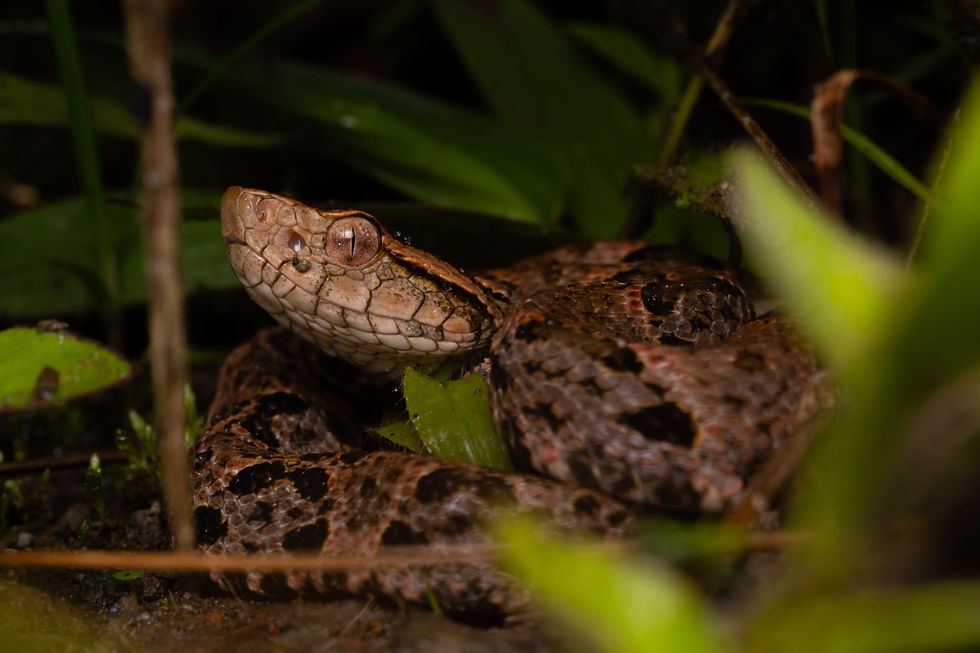
Let’s start with our most common viper and one of my personal favourites: Bothrops asper, or the central American Lancehead, Equis, Terciopelo, ver-de-lance or the Ultimate Pitviper.
This young lady is just over 30cm long, already weighing a solid 18 grams.
This species is most likely responsible for most venomous snake bites in central and northern south America. This is likely due to their natural history adapting well to human disturbed habitats such as pastures or plantations. They are viviparous, sexually mature in about 3 years (~90cm for males; ~110cm for females), possess a potent venom and are incredibly well camouflaged in leaf litter. This combination makes them prone to human-animal conflict.
We have never had any incidents with any of these animals, and we are very happy to see juveniles of this species showing us that they are reproducing and well-fed. This shows that this species does not mind our monitoring efforts and that we can produce meaningful results regarding the spatial ecology of these animals in the upcoming years and hopefully give some insight into where, when and why snakebites happen.

Secondly, we encountered this 47cm long Bothrops osbornei, or Osborne's Lancehead.
This species is endemic to few localities in northern Peru and the western slopes of the Andes in Ecuador. They generally appear at altitudes over 500m asl. Both pattern and natural history wise they seem to replace Bothrops punctatus at higher altitudes.
They are regarded as semiarboreal, and indeed we have only observed them resting and coiled up above the ground, from neonates on shrubs at ankle height, to adults in trees over 5 meters above the ground. Seeing this individual made us especially happy as we encountered several juvenile, freshly born individuals at this time last year. Size wise this individual matches a 2nd-year specimen and also the coloration would match this age category, as it is not as bright as juveniles but not yet dark like large adults.
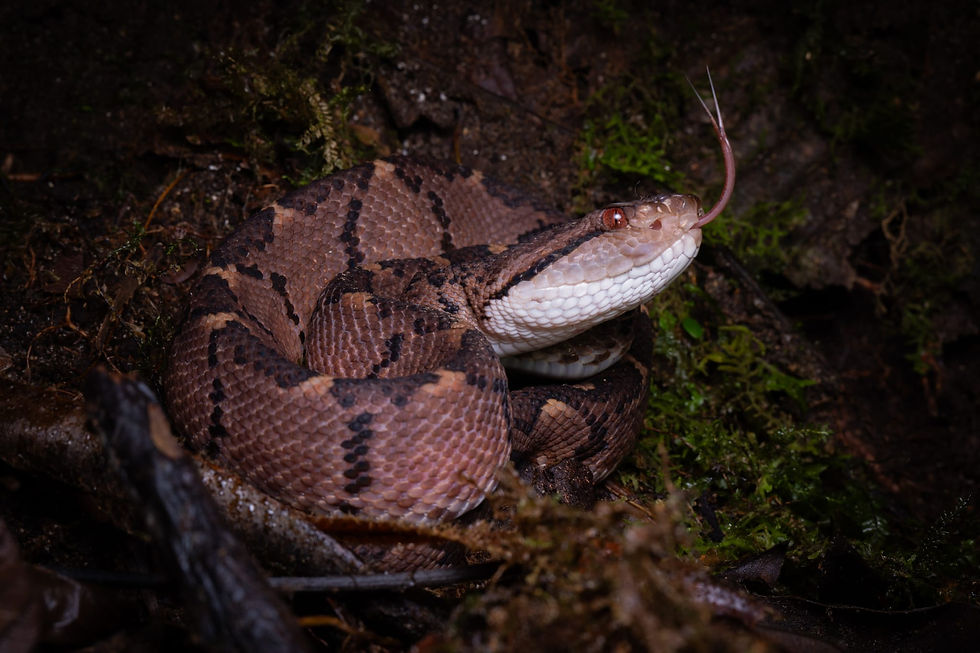
Last but certainly not least, we encountered this young Chocoan Bushmaster, Lachesis acrochorda only 150m from our station house.
This male had a total body length of only 60cm, this matches the size of an individual born within the past 6 months. This species has been recorded to reach body lengths of up to 3m. We very much hope to see this guy again in a few years in all his glory.
Bushmasters are one of the few oviparous (egg laying) pit vipers. Their venom tends to be significantly more potent when compared to other snakes in the area. Sadly, this genus is notorious for restricting their range to good quality, primary tropical rainforest. Having them in some of the more secondary parts of the UPDC reserve is a great sign to us, both showing the positive effect of the last 20 years conservation efforts and that monitoring these animals long-term will lead to significant results.
A little story about the Bushmaster in UPDC:
The first time a Bushmaster was registered in our reserve was in late 2023, this was a close to 2m long individual found during the first herpetological diversity inventory done by Ecuadorian Herpetologist Alex Kevin Delgado.
The following January of 2024, we found 2 juvenile individuals in the same area, and later in the year another large individual. Since then, we introduced a trail transect based herpetological monitoring in 2025, during which we did not encounter any individuals of this species. This makes us all the happier to have encountered this baby forest guardian this January.
We certainly hope to encounter this elusive species more often and to see their populations prosper.
Let us know which one is your favourite
Central American Lancehead
Bushmaster
Osborne's Lancehead
All in all we are very pleased with how this field season is going, and most importantly we are extatic to see that our viper populations are happy and healthy.
With news around the world, from geopolitics to massive declines in vertebrate populations, we hope our 3 little superstars can brighten up your day!


Comments